Hegel famously described Napoleon as the world soul riding through Jena, the city where he was teaching between 1801-1806. The German philosopher believed every era to be ruled by a particular spirit of the time, which, in 1806, was horse riding outside his university in the guise of the Emperor of France. Similarly, Hegel argued that every art form is an expression of its Zeitgeist; this might sound like a platitude if detached from his systematic philosophy of the world as spirit, but it’s true that there are works of art which perfectly capture the spirit of their time.
One such work is Franco Leprino’s beautiful Integrati… Disintegrati [Integrated … Disintegrated] (1977), an obscure gem from the vaults of Italian 1970s pop avant-garde. I am intentionally using ‘pop’ as opposed to ‘academic’: a distinction which might appear irrelevant today, but which was fundamental to the critical discourse at the time, as the record title itself alludes to. In fact, Integrati… Disintegrati is a play on wordson Umberto Eco’s seminal Apocalittici e Integrati [translated as Apocalypse postponed].
Published in 1964 and widely referenced during the 1970s, the book set out to analyse the culture industry by offering a set of tools to understand its products. Eco rejected both attitudes – the integrated, too optimistic in its celebration of mass culture, and the apocalyptic, “surviving by packaging theories on decadence” – accusing them of essentially reinforcing the same prejudices about popular culture.
By moving directly from integration to disintegration, Franco Leprino (born 1953) seemed to affirm his position as an outsider. A Sicilian native, the musician moved to Milan in the late 1970s to study guitar and composition. “In those first years in Milan” he wrote in the liner notes of the 2014 reissue of the record “I was like a sponge, absorbing everything that the city had to offer me”. Amidst the political and social turmoil of the Years of Lead, the city was home to a thriving art scene, a wild mix of Fluxus, experimental music, cabaret, and cutting-edge design. To Leprino, neither the immediacy of rock nor the stiffness of academic music felt suitable to soundtrack the creative frenzy of the time.
Integrati… Disintegrati was born during a time of transition and transformation: from my ‘rock’ phase from the age of 15 to 22, to my exploration of new contemporary and avant-garde music. There was political activism; I was reading Joyce and Gadda; I was observing what was happening in experimental theatre and avant-garde movements like Fluxus. Rock music felt too confining to me, it seemed, paradoxically, unsuited to the the cultural revolutions that were moving toward social engagement and change.
This was a common sentiment: during the 1970s, most Italian ‘pop’ avant-gardists were shedding their rock background in the effort to create a more accessible form of experimental music. In this respect, Integrati… Disintegrati is paradigmatic of a decade-long endeavour to transcend the barriers between ‘serious’ and pop music.
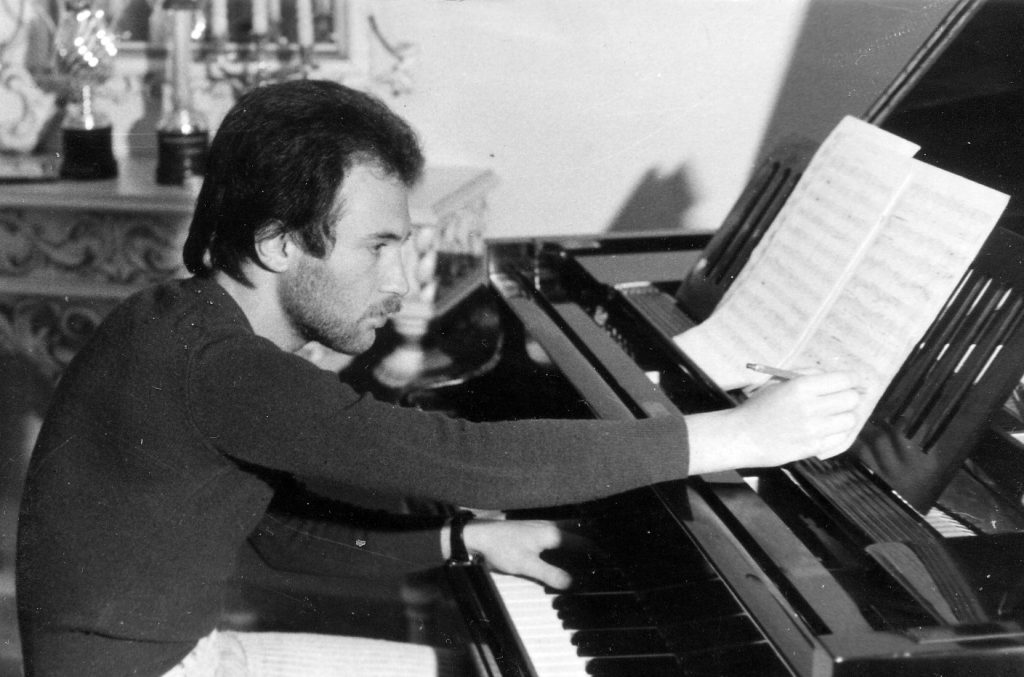
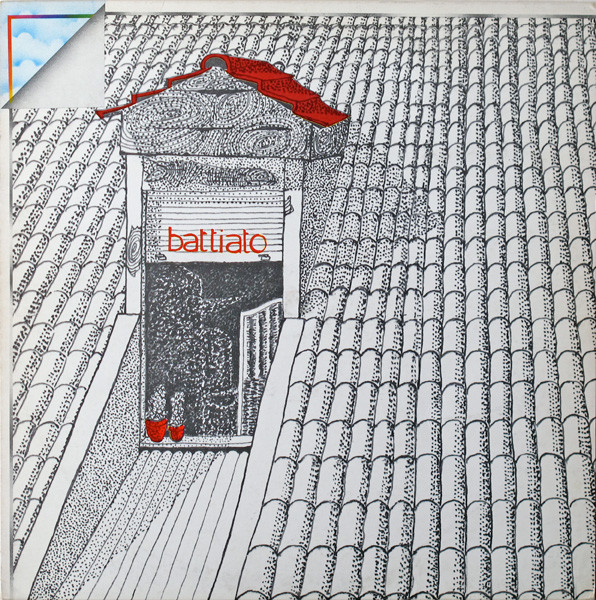
Recorded in 1977 by Leprino himself and a small chamber ensemble, the album is a long suite that unfolds across both sides. Traditional instruments – piano, acoustic guitar, oboe and flute – are paired with Moog, magnetic tape and the VCS 3, which the composer bought from Franco Battiato. The music is an eclectic yet very harmonious journey through minimalism, krautrock and musique concrète. Its influences are very clear: early Tangerine Dream and Popol Vuh, Battiato’s groundbreaking Sulle Corde di Aries, and a hint of Morricone’s soundtracks for Sergio Leone.
The record, however, is much more than the sum of its influences. It may not be the most original LP out there, but the quality of its writing makes up for it. What stands out is just how harmonic it sounds, especially in its melodic passages, underpinned by sense of melancholy which to me is a typical feature of Italian music.
As a testament to its epoch-defining quality, Integrati… Disintegrati features in the pages of Ufo 78 by the writer collective Wu Ming. The novel is a fictionalised account of alleged alien abductions happening during the kidnapping and murder of former Italian PM Aldo Moro by left-wing terrorist group Brigate Rosse [Red Brigades] in March 1978. A prominent figure in the Christian Democratic Party, Moro was attempting to forge an alliance with the Communist Party, the so-called compromesso storico [historic compromise], which the terrorists aimed to disrupt.
Wu Ming skillfully intertwines truth and fiction to paint a faithful picture of Italy in 1978, caught between armed rebellion, student protests and counterculture. Music plays an important role in lending the novel a sense of authenticity: one of its key settings is the Hallogallo, an alternative record store named after the classic NEU! song. The shop’s owner, self-described “cosmic courier” Jimmy Fruzzetti, plays Leprino’s LP to his love interest Milena, an anthropologist specialising in cults and alternative religions.
Jimmy was sitting opposite Milena. They were perched on tall stools, Jimmy leaning back, his back against the wall. The Hallogallo had been closed for half an hour, lit by three of its six lamps and filled with an indefinable kind of music, complex and seductive at the same time: electronic sounds, guitar arpeggios, flutes, clusters of piano notes, and, at one point, even the cry of a newborn baby.
“Who are they?” Milena asked, pointing to the record spinning on the turntable.
“It’s just one person,” Jimmy said, his hands busy heating hashish. “His name is Franco Leprino. The album is called Integrati dot dot dot Disintegrati.”
“Does it actually say ‘dot dot dot’? In letters?”
“No, meine Liebe, with three dots… How do you call them?”
“An ellipsis.”
“Exactly. And that ellipsis is important, because it makes the title mean all sorts of things. Do you like it?”
“Yes”.
Jimmy and Milena’s love story, paralleling the fate of the post-68 counterculture, wouldn’t survive 1978. Similarly, by the end of the 1970s the peculiar form of experimentalism that had characterised the Italian ‘pop’ avant-garde – an original fusion of minimalism, kraut influences and local colour – was also fading away. In 1977, the nihilism of punk exploded and shortly after disco music ushered in the years of disengagement and their withdrawal into the private. Integrati… Disintegrati is the swan song of an era, perhaps even a little past its time.
Unfortunately, the album remains the only record Leprino ever released. A second LP was in the works for the renowned Cramps Records, but it was never published following the death of the label’s founder, Gianni Sassi. Some of its tracks are available on the virtually impossible-to-find 2009 CD Franco Leprino 1977-1987. Original Versions. Today, Leprino works primarily as a filmmaker, focusing on documentaries about classical musicians.
Integrati… Disintegrati may not be a classic, but it’s a testament to its time that simultaneously transcends it through the beauty of its music. Similarly, and on a far more modest scale, to Napoleon on his horse.